Between March and August 2026, patients in Renal Care 360’s Connected Care program submitted 45,860 home blood pressure readings. Patients receiving personalized check-ins through Miranda, Renal Care 360’s AI care agent, averaged 31.6 readings per active month, compared with 22.5 among patients receiving standard weekly reminders.
The findings highlight how personalized outreach can support Connected Care’s broader mission: helping patients stay engaged in their care between visits.
Connected Care: supporting patients beyond the appointment
Renal Care 360 provides value-based kidney care for people living with chronic kidney disease (CKD) and end-stage renal disease (ESRD). Its Connected Care program combines care coordination, remote monitoring, education, and emotional support to help patients manage their health at home.
Through Renal@Home, Renal Care 360’s remote patient monitoring partner, patients receive connected blood pressure cuffs that transmit readings directly into Connected Care. These readings give the care team ongoing visibility into patients’ blood pressure between appointments.
The challenge: keeping patients engaged over time
Home blood pressure readings give care teams information they can use to support patients with kidney disease. Maintaining that visibility depends on patients continuing to measure over time.
Standard weekly reminders provide a consistent prompt. Renal Care 360 wanted to offer an additional approach: personalized check-ins that respond to each patient’s readings and engagement.
The approach: clinically designed, personalized outreach
Renal Care 360’s clinical team designed the engagement approach, including whom to contact, when to reach out, what to say, and when to involve a care team member. Miranda carries out that approach by text with patients who have opted in.
Miranda:
- Follows up when readings fall outside the expected range and flags concerns to the care team.
- Encourages patients who are staying on track.
- Checks in when patients stop submitting readings.
Patients who prefer standard weekly reminders remain on that track. Patients who ask to stop receiving outreach are removed.
The results: more readings and fewer low-engagement months
March 1–August 31, 2026 | 45,860 total home blood pressure readings
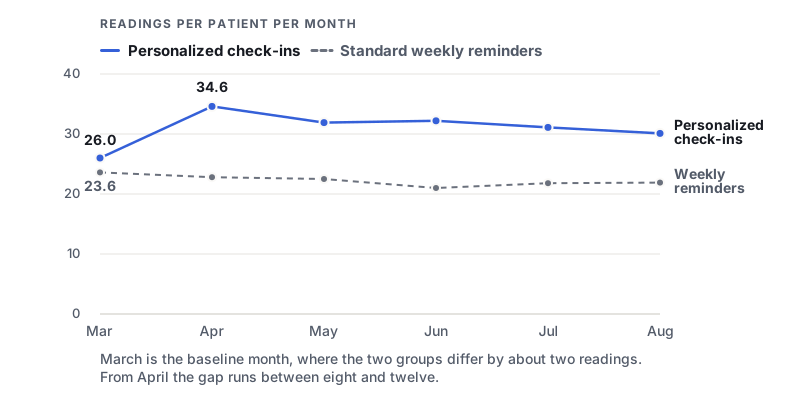
Patients receiving personalized check-ins averaged 1.4× as many readings—about 40% more, or nine additional readings per active month.
The personalized check-in group had higher reading frequency in March, the baseline month, and in every subsequent month through August.
Low-engagement months were also less common in that group. Among months with at least one reading, 10% had five or fewer readings, compared with 22% in the standard reminder group. Fewer low-engagement months can give care teams more consistent information to review between visits.
Across both outreach tracks, eight of the 420 patients who received outreach asked to stop.
“Connected Care is built on a simple belief: patients deserve personalized support between visits. Miranda helps our clinical team extend that support, encouraging patients to stay engaged in monitoring their blood pressure at home. These findings are encouraging and reinforce our commitment to proactive, coordinated care that keeps patients connected to their care team.”
— Joe Cashia, Founder and CEO, Renal Care 360
Understanding the findings
This analysis used device-reported home blood pressure readings collected from March 1 through August 31, 2026, with March serving as the baseline month.
An active month is a month in which a patient submitted at least one reading. Months with no readings were excluded from the per-patient averages and patient-month percentages above.
Patients selected their outreach track based on their consent preferences; they were not randomly assigned. The difference in reading frequency was already present at baseline. These results therefore show an association between personalized check-ins and higher monitoring frequency; they do not establish that the check-ins caused the difference. The analysis measures monitoring engagement, not changes in blood pressure control or clinical outcomes.
Bringing Connected Care to more patients
Connected Care is designed and run by Renal Care 360’s clinical team, with Renal@Home as its remote patient monitoring partner. Miranda is powered by the Gravity Rail platform.
For organizations seeking a fully managed care program: Contact Renal Care 360 to learn about Connected Care, delivered with Renal@Home.
For healthcare teams building their own AI-supported programs: Learn about Gravity Rail’s platform for healthcare AI agents at gravityrail.com.