Preventing Emergency Dialysis Starts: How Automated Patient Preparation Saves Lives
Nearly half of dialysis patients start treatment unprepared. Learn how automated care coordination can improve optimal start rates and patient outcomes.
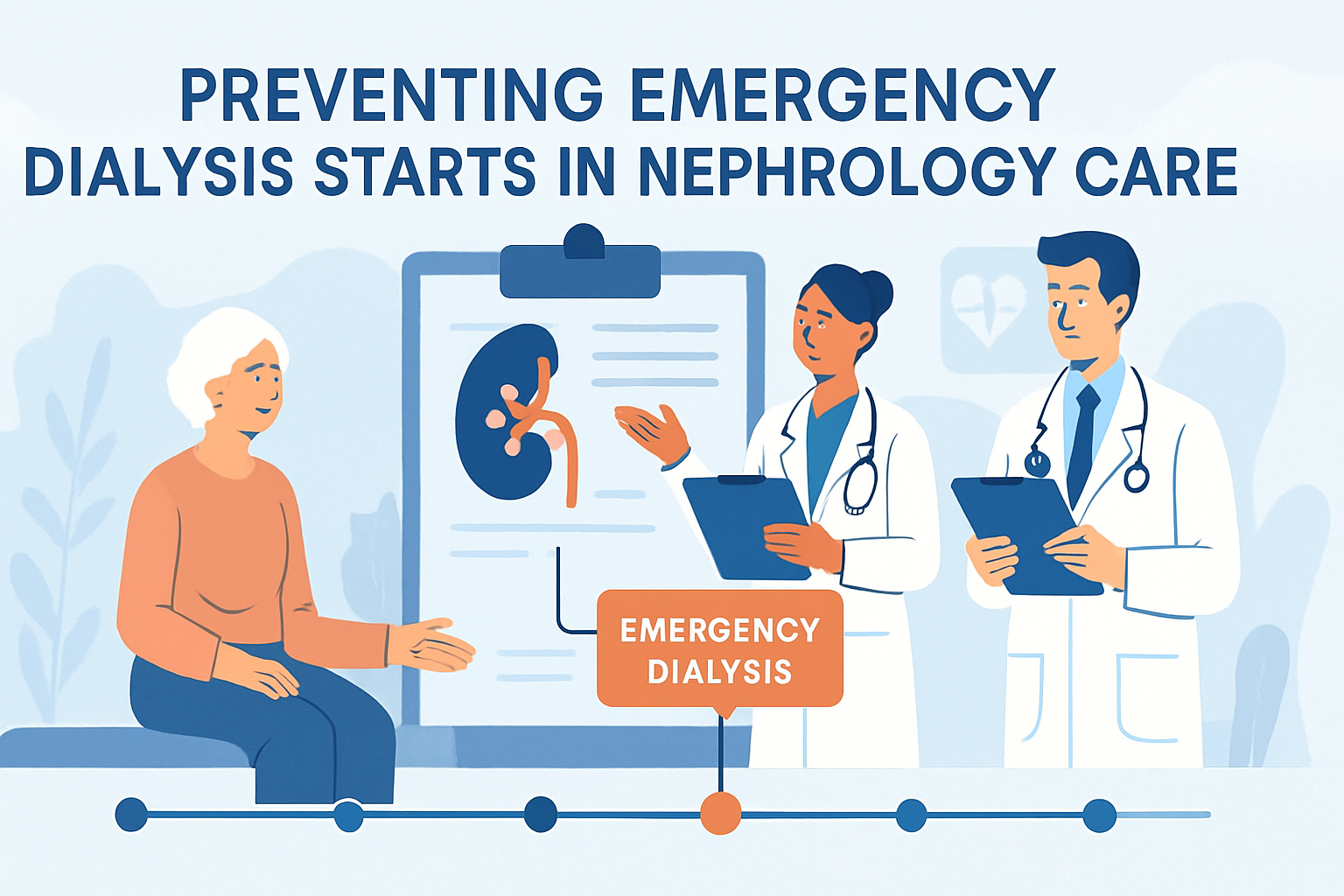
Every nephrology practice manager knows the sinking feeling: a patient shows up in the emergency department, kidney function failing, with no arteriovenous access prepared and no understanding of what dialysis actually means. It happens far too often—and the consequences are severe.
Worldwide, 24-49% of patients commence dialysis via emergency or unplanned start. In the United States, 60% of patients initiate dialysis with no arteriovenous access or predialysis nephrology care in place. These aren't just statistics—they represent fundamental failures in patient preparation that directly impact survival, quality of life, and your practice's quality metrics.
The Hidden Cost of Unpreparedness
When patients start dialysis unprepared, the outcomes tell a stark story. Research shows that emergency start patients have 74.2% one-year survival compared to 87.4% for planned starts—a 13% mortality difference that's entirely preventable. In one study, every patient who died within four months had experienced emergent dialysis initiation.
But mortality isn't the only concern. Unprepared patients face cascading disadvantages:
- Reduced transplant access: Unpreparedness correlates with 40-58% lower likelihood of transplant waitlist placement
- Higher costs: Unplanned starts increase pre-dialysis costs by $49,168 and post-dialysis costs by $16,565 per patient per year
- Limited modality choice: Only a minority of unplanned start patients receive education about home dialysis options
- Quality metric impact: Your optimal start rates, transplant referral ratios, and patient satisfaction scores all suffer
The problem isn't that care teams don't understand what patients need. It's that patients fall through the cracks during the critical months between CKD diagnosis and dialysis initiation.
Why Patients Slip Through the Gaps
Traditional care coordination relies on episodic clinic visits and manual phone outreach. Here's what typically happens:
- Patient diagnosed with Stage 4 CKD leaves clinic with appointment cards for access evaluation
- Life gets busy—patient misses the vascular surgery consultation
- Practice attempts to call patient for rescheduling, leaves voicemail
- Patient doesn't return call (busy at work, didn't recognize the number, forgot)
- Months pass with no engagement
- Patient's kidney function declines to crisis levels
- Emergency dialysis start via catheter, no access prepared, no modality education
The gap isn't intentional. It's systemic. Practices lack tools to maintain consistent patient engagement during the lengthy pre-dialysis phase when preparation is critical but patients feel relatively well and don't prioritize nephrology appointments.
According to communication research in nephrology, limited time during routine clinic visits is the most commonly cited barrier to CKD education. Patients report feeling "barraged with information" during appointments and pressured to make critical decisions without adequate preparation time.
The Automated Care Coordination Solution
What if your practice could maintain daily touchpoints with every pre-dialysis patient without adding staff? That's the promise of AI-powered conversational automation.
Here's how it works in practice:
Milestone-Based Education Sequences
When a patient reaches Stage 4 CKD, they automatically enter a progressive education pathway delivered via SMS—the channel 79% of patients prefer for provider communication. Over 4-6 weeks, they receive:
- Digestible explanations of kidney function and what dialysis means
- Comparisons of dialysis modalities (hemodialysis vs. peritoneal dialysis)
- Information about access placement and why timing matters
- Answers to common questions through conversational exchanges
Unlike traditional binders or one-time classes, this stepwise approach prevents information overload. Each message builds on previous knowledge, checking patient understanding and adjusting pace based on responses.
Automated Appointment Coordination
When it's time to schedule access evaluation, the system sends conversational SMS:
"Hi Sarah, it's time to schedule your access evaluation with Dr. Martinez. This appointment will assess which dialysis access will work best for you. Would you prefer a morning or afternoon appointment?"
If the patient doesn't respond within 48 hours, automated follow-ups continue with varying message approaches. If the patient indicates confusion or concern, the system flags the care team for human intervention—providing full conversation context so coordinators can jump in effectively.
Engagement Monitoring and Early Intervention
This is where automation prevents patients from slipping through gaps. The system tracks:
- Which educational milestones the patient has completed
- Whether they've scheduled access evaluation
- If they've missed scheduled appointments
- Their level of engagement (responsive vs. unresponsive)
When a patient misses a critical appointment, automated outreach begins immediately:
"We noticed you missed your appointment with Dr. Smith about access placement. This is an important step in preparing for dialysis. Would you like help rescheduling?"
For patients who remain unresponsive after multiple attempts, the system escalates to the care team with specific context: "Patient has not scheduled access evaluation despite 3 outreach attempts over 2 weeks. Last engagement was 14 days ago."
Daily Check-Ins for Advanced CKD
As patients approach dialysis, daily SMS check-ins maintain continuous engagement:
"Good morning! Did you take your phosphate binder with breakfast today?"
These brief exchanges (taking patients 30 seconds to respond) provide accountability and catch adherence issues early. They also keep dialysis preparation top-of-mind, making patients more likely to prioritize upcoming appointments.
Real-World Impact
What does this look like in practice? Consider the difference:
Traditional approach:
- Patient receives access evaluation referral at clinic visit
- Scheduler calls to book appointment → voicemail
- Patient doesn't return call
- 3 weeks later, second call attempt → patient books appointment 4 weeks out
- Patient misses appointment (forgot, work conflict)
- Practice attempts to reschedule → voicemail tag begins again
- 4 months pass before access actually evaluated
- Patient's kidney function deteriorates faster than expected
- Emergency dialysis start via catheter
Automated coordination approach:
- Patient receives SMS same day as clinic visit: "Ready to schedule your access evaluation?"
- Patient responds "yes" → system offers appointment times
- 2 days before appointment: SMS reminder with prep instructions
- Morning of appointment: "Your appointment with Dr. Martinez is at 2pm today at [address]. Do you still plan to attend?"
- Patient responds "can't make it, sick" → system immediately offers alternative times
- Rescheduled appointment confirmed within minutes
- Patient attends evaluation, access placed with adequate maturation time
- Planned dialysis start with functioning access
The difference in patient outcomes—and your practice metrics—is dramatic.
Research shows that when practices implement structured education programs for pre-dialysis patients, peritoneal dialysis rates increase by 66% even among those who originally experienced unplanned starts. Patients who receive adequate preparation are significantly more likely to:
- Choose home dialysis modalities
- Have functional arteriovenous access at first dialysis session
- Get placed on transplant waitlists
- Experience better one-year survival rates
Addressing the "Will Patients Actually Use This?" Question
Practice managers often worry about patient adoption, particularly with older CKD populations. The research is reassuring:
- 95% of patients have daily SMS access
- 79% of patients want text-based provider communication
- Automated SMS reminders reduce appointment no-shows by 50% in chronic care settings
- Patients prefer asynchronous communication they can engage with when convenient
Unlike patient portals (which require logins and digital literacy) or phone calls (which require availability during business hours), SMS-based conversational automation meets patients where they already are. The interface is familiar—just texting back and forth like they would with family.
For patients who prefer phone calls, the same conversational automation works via voice, with AI assistants conducting natural conversations that feel supportive rather than robotic.
Getting Started with Automated Dialysis Preparation
Implementing automated care coordination for pre-dialysis patients doesn't require overhauling your entire workflow. Here's a practical starting point:
-
Identify your at-risk population: Pull a list of Stage 4-5 CKD patients who haven't yet scheduled access evaluation or completed dialysis modality education
-
Define critical milestones: Map the key preparation steps (education completion, access evaluation scheduled, access surgery completed, modality decision made)
-
Create conversational workflows: Work with your care team to script the educational content, appointment coordination messages, and escalation triggers that reflect your practice's approach
-
Launch with a pilot group: Start with 20-30 patients to refine messaging and workflows before scaling to your full pre-dialysis population
-
Track outcomes: Monitor optimal start rates, transplant referral ratios, and time-from-referral-to-access-placement
Most importantly, automated coordination doesn't replace your care team—it empowers them to focus on complex cases while ensuring no patient slips through the cracks during routine preparation.
The Bottom Line
Nearly half of dialysis patients start treatment unprepared, facing preventable mortality risk, reduced transplant access, and worse quality of life. The gap isn't lack of clinical expertise—it's lack of systematic patient engagement during the critical pre-dialysis phase.
AI-powered conversational automation provides the consistent touchpoints, milestone tracking, and early intervention that traditional care coordination can't deliver at scale. By maintaining daily engagement with every pre-dialysis patient through their preferred communication channel, you can:
- Increase optimal start rates and improve quality metrics
- Reduce emergency department dialysis initiations
- Improve transplant waitlist placement
- Enhance patient satisfaction and preparedness
- Free your care coordinators to focus on high-need cases
Your patients deserve to start dialysis prepared, informed, and ready. Automated care coordination makes that possible for every patient, not just the most proactive ones.
Ready to see how automated patient preparation could work in your practice? Learn more about Gravity Rail's conversational automation platform or schedule a demo to explore dialysis preparation workflows tailored to nephrology.